
Soft Language Is Quiet Censorship
An opinion on how softened euphemisms and filter-dodging words like “unalive” quietly censor the subjects that most need plain language.
Written by Gregory Ferraro for The Daily TitanIllustrated by Hayley Lucas for The Daily TitanWritten for The Daily Titan and left unpublished.
Visit The Daily Titan ↗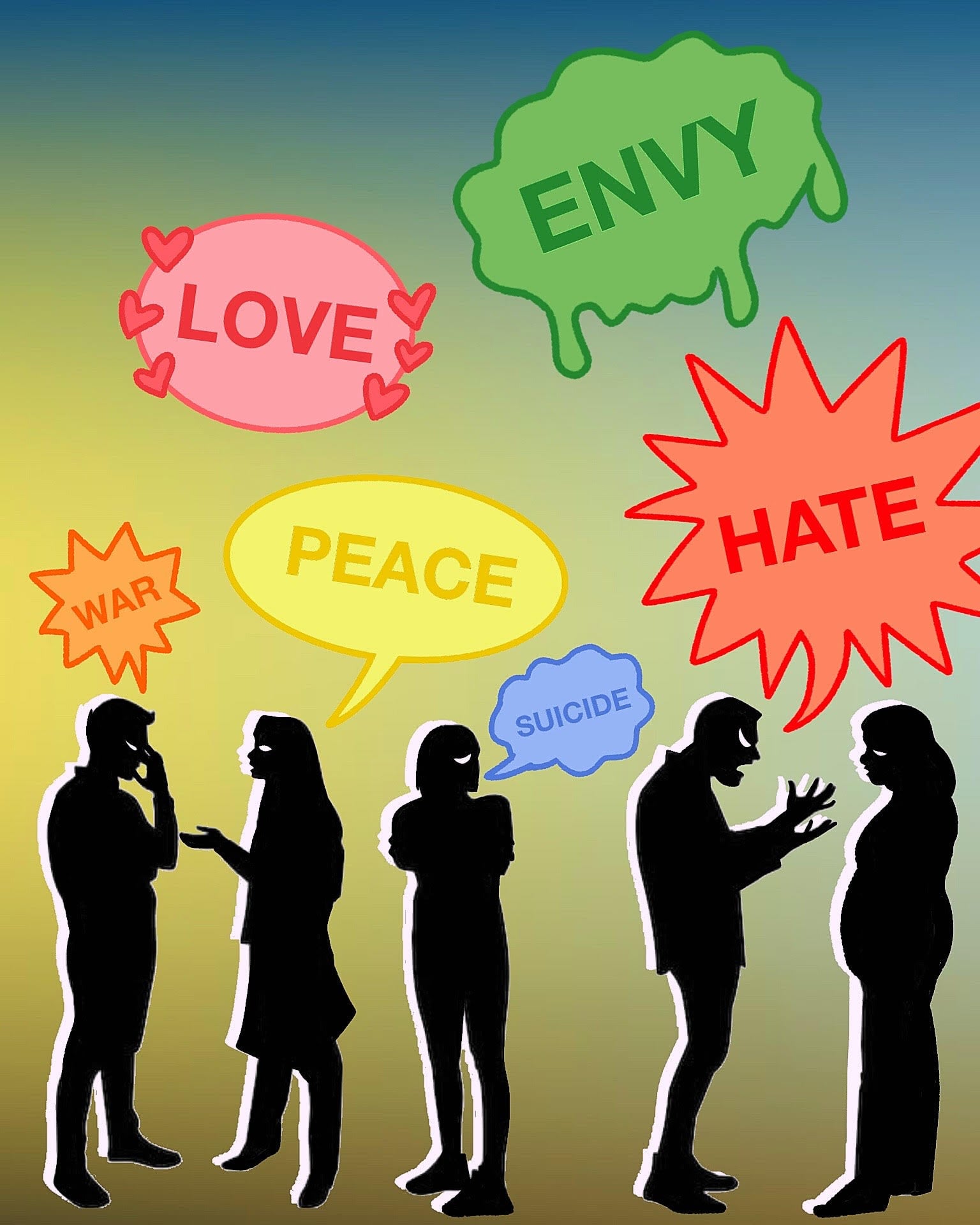
Gregory Ferraro is a staff writer of the Daily Titan. All opinions expressed in this article are those of the author and do not reflect the opinions of the Daily Titan as a whole.
In a society where a seemingly manufactured political divide is rampant, constant worldwide tragedies are accessible at a single click and productive conversation has become nearly non-existent, communication has been changed for good.
“Rather than opening honest and meaningful dialogue, contextual and accurate words are being sacrificed for softened and toned-down euphemisms, often influenced by social media algorithms.”
Softening language dilutes the meaning behind words by destroying their accuracy, emotion and sensitivity. When the words needed to discuss serious topics are censored, those conversations lose their legitimacy, and people become less willing to have them at all. People should instead use language that maintains integrity and specificity to the meaning it holds.
Famous comedian George Carlin is said to have popularized "soft language" in his 1990 special, "Doin' It Again." Professor Emeritus Robert Gass, an expert in human communication studies of persuasion, social influence, argumentation and critical thinking, used some of his examples to explain its meaning.
"He was a famous 60s comedian, and he's the one who coined the term soft language. He said, 'Americans have trouble facing the truth, so they have to rename things,'" said Gass. "Your uncle doesn't 'die,' your uncle 'passes away,' or is 'in a better place.' Terms like 'dump' are called 'landfill,' or the CIA doesn't 'murder' people, it 'neutralizes' them."
Euphemisms like Carlin described are words or phrases utilized to convey unpleasant, depressing or prohibited information, according to the American Journal of Public Diplomacy and International Studies.
Ashley Tamengko, a fourth-year psychology major, believes that these alternate ways of delivering information can be comforting and can protect some individuals.
"I think words can be very triggering for some people who are experiencing things with their loved ones, or just people they know, so I think using softer language is more appropriate in conversation," said Tamengko. "How we talk to people is really important, and also how we engage on social media with people. It's important to be mindful and respectful to other people, because you never know what they go through."
Professor Jon Bruschke, the immediate past chair of the Human Communication Studies Department and longtime debate coach at CSUF, agrees that word choice holds immense importance.
"Language does make a difference, language helps shape the way we think about the world and language choices matter," Bruschke said. "There's more of a sense that you need to choose your words carefully and try to avoid setting off extreme reactions."
With social media's increased integration and influence on societal standards, the language regulations imposed on users can redefine the interpretation of formerly heavy-hitting words. Users often seek creative alternatives to such words to avoid a potential guidelines violation, ultimately mitigating the severe language required of taboo topics in discussion.
For instance, TikTok regulates speech that violates its Community Guidelines on Safety and Civility, Mental and Behavioral Health, and Sensitive and Mature Themes, among other categories.
This superficially heightens extensive protection, but is ineffective, according to Gass.
"There are algorithms that filter some kinds of terms, so you can't say someone was 'raped,' but instead, what people might say is 'graped,' and you can't say 'murdered' or 'killed' because an algorithm or a filter might kick that word out or disappear the post, so people will say 'unalive,'" said Gass.
"It's partly a convenience to get around the filters and algorithms, but at the same time, anytime we're using euphemisms, we tend to sanitize concepts – they don't sound as bad – and it also tends to normalize them."
"Whoever gets to name things has a tremendous amount of power in any discussion," said Gass. When that power belongs to algorithms and platforms, the words we are allowed to use shrink, and so do the conversations we are able to have.
“The accuracy of speech when sharing important information should be a priority to prevent the minimization of serious topics and to connect people to others' stories.”